
Undergraduate
Undergraduate Programs in the Department of Mechanical Engineering, BUET
Degree Requirements
Advising & Academic Support
Scholarships & Awards
Program Educational Objectives (PEO)
PEO-1: Develop successful careers with a lifelong desire to conduct research, development and innovation in and related to Mechanical Engineering.
PEO-2: Update core expertise and abilities to ethically compete in a multicultural global environment.
PEO-3: Think critically and creatively and excel in applying the fundamentals of Mechanical engineering with self-confidence to adapt to ever-changing global challenges.
PEO-4: Embrace impactful leadership roles in industry, academia, and government organizations, as well as in developing collaboration among them.
|
PEOs |
Mission 1 |
Mission 2 |
Mission 3 |
Mission 4 |
|
PEO 1 |
√ |
|
|
|
|
PEO 2 |
|
√ |
|
|
|
PEO 3 |
|
|
√ |
|
|
PEO 4 |
|
|
|
√ |
Program Outcomes (POs)
PO(1)- Apply knowledge of mathematics, natural science, engineering fundamentals and an engineering specialization as specified in K1 to K4, respectively to the solution of complex mechanical engineering problems.
PO(2)- Identify, formulate, research literature and analyse complex mechanical engineering problems reaching substantiated conclusions using first principles of mathematics, natural sciences and engineering sciences. (K1 to K4)
PO(3)- Design solutions for complex mechanical engineering problems and design systems, components or processes that meet specified needs with appropriate consideration for public health and safety, cultural, societal, and environmental
considerations. (K5).
PO(4)- Conduct investigations of complex problems using research-based knowledge (K8) and research methods, including design of experiments, analysis and interpretation of data, and synthesis of information to provide valid conclusions.
PO(5)- Create, select and apply appropriate techniques, resources, and modern engineering and IT tools, including prediction and modelling, to complex mechanical engineering problems, with an understanding of the limitations. (K6)
PO(6)- Apply reasoning informed by contextual knowledge to assess societal, health, safety, legal and cultural issues and the consequent responsibilities relevant to professional engineering practice and solutions to complex mechanical engineering problems. (K7)
PO(7)- Understand and evaluate the sustainability and impact of professional engineering work in the solution of complex mechanical engineering problems in societal and environmental contexts. (K7)
PO(8)- Apply ethical principles and commit to professional ethics and responsibilities and norms of engineering practice. (K7)
PO(9)- Function effectively as an individual, and as a member or leader in diverse teams and in multi-disciplinary settings.
PO(10)- Communicate effectively on complex engineering activities with the engineering community and with society at large, such as being able to comprehend and write effective reports and design documentation, make effective presentations, and give and receive clear instructions.
PO(11)- Demonstrate knowledge and understanding of engineering management principles and economic decision-making and apply these to one’s own work, as a member and leader in a team, to manage projects and in multidisciplinary environments.
PO(12)- Recognize the need for, and have the preparation and ability to engage in independent and life-long learning in the broadest context of technological change.
Courses Offered
In the curriculum for the undergraduate programme, besides the professional courses pertaining to Mechanical Engineering, there is a strong emphasis on acquiring a thorough knowledge in the basic sciences of Mathematics, Physics and Chemistry. Due importance is also given for the study of several subjects in Humanities and Social Sciences which, it is expected will help the student to interact more positively with the society in which he lives. Thus, the course contents of the undergraduate programs provide a harmonious blend of basic sciences and their engineering applications as well as their social relevance.
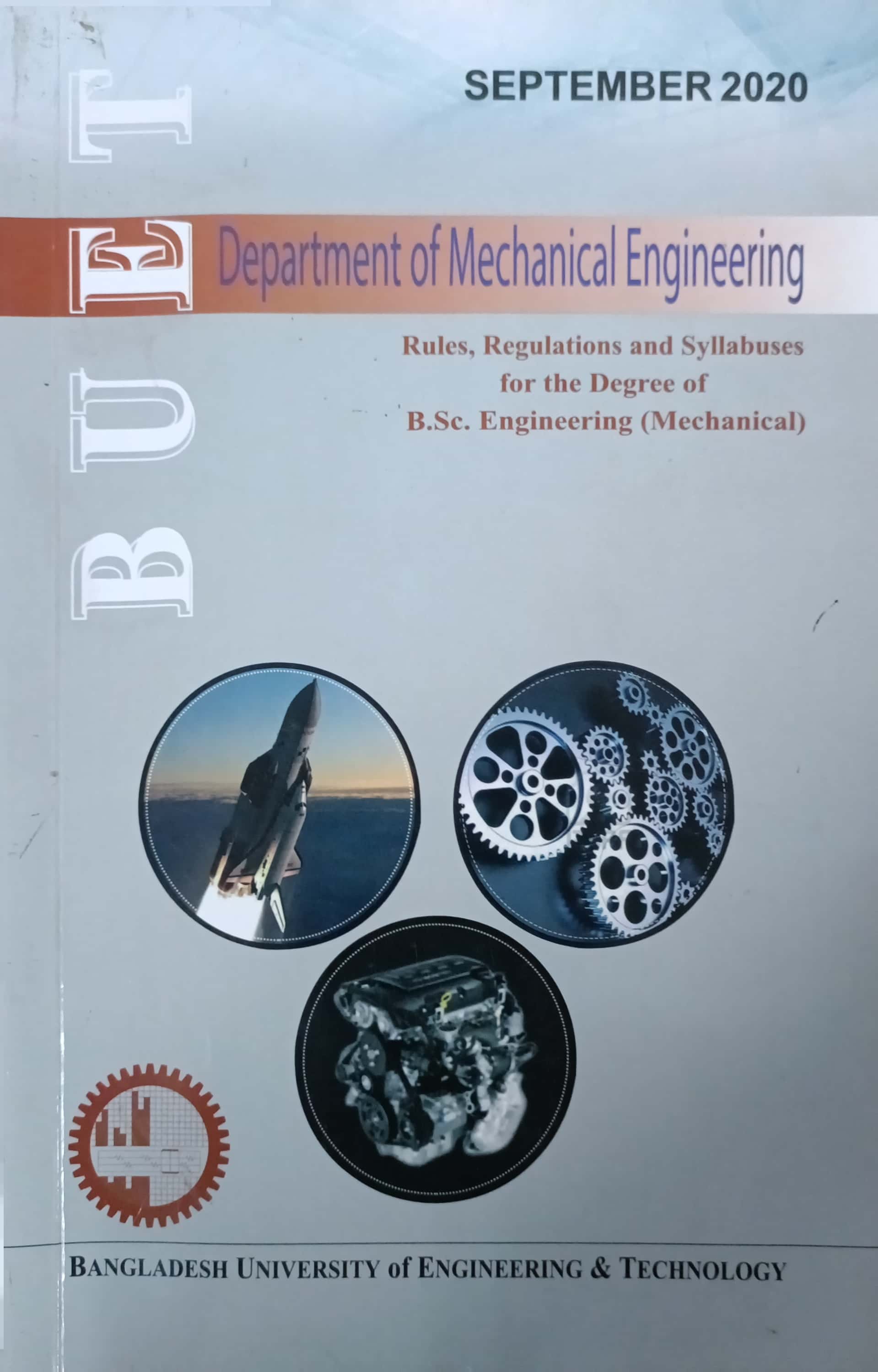
.png)
The first two years are spent on basic work in mathematics and physics, and an introduction to the fundamental areas of Mechanical Engineering. The last two years completes the development of knowledge in most of the major branches of Mechanical Engineering and related topics. The third and subsequent terms build directly on the knowledge of the basic subjects gained in the first two terms and go on to develop competence in specific disciplines. In the final year, the students get the opportunity to choose some optional specialized courses and carryout a comprehensive project and thesis work. The Project and Thesis work provides an opportunity to develop initiative, self-reliance, creative ability and engineering judgement.
More detail and specific information on the courses that are offered can be obtained from the following »
Undergraduate Booklet (Old Syllabus)Undergraduate Booklet (New Syllabus)